
IEC Power Cable Connector Types Explained: C13, C14, C15, C19 & C20 Differences
IEC C13 – One of the Most Common IT Power Connectors
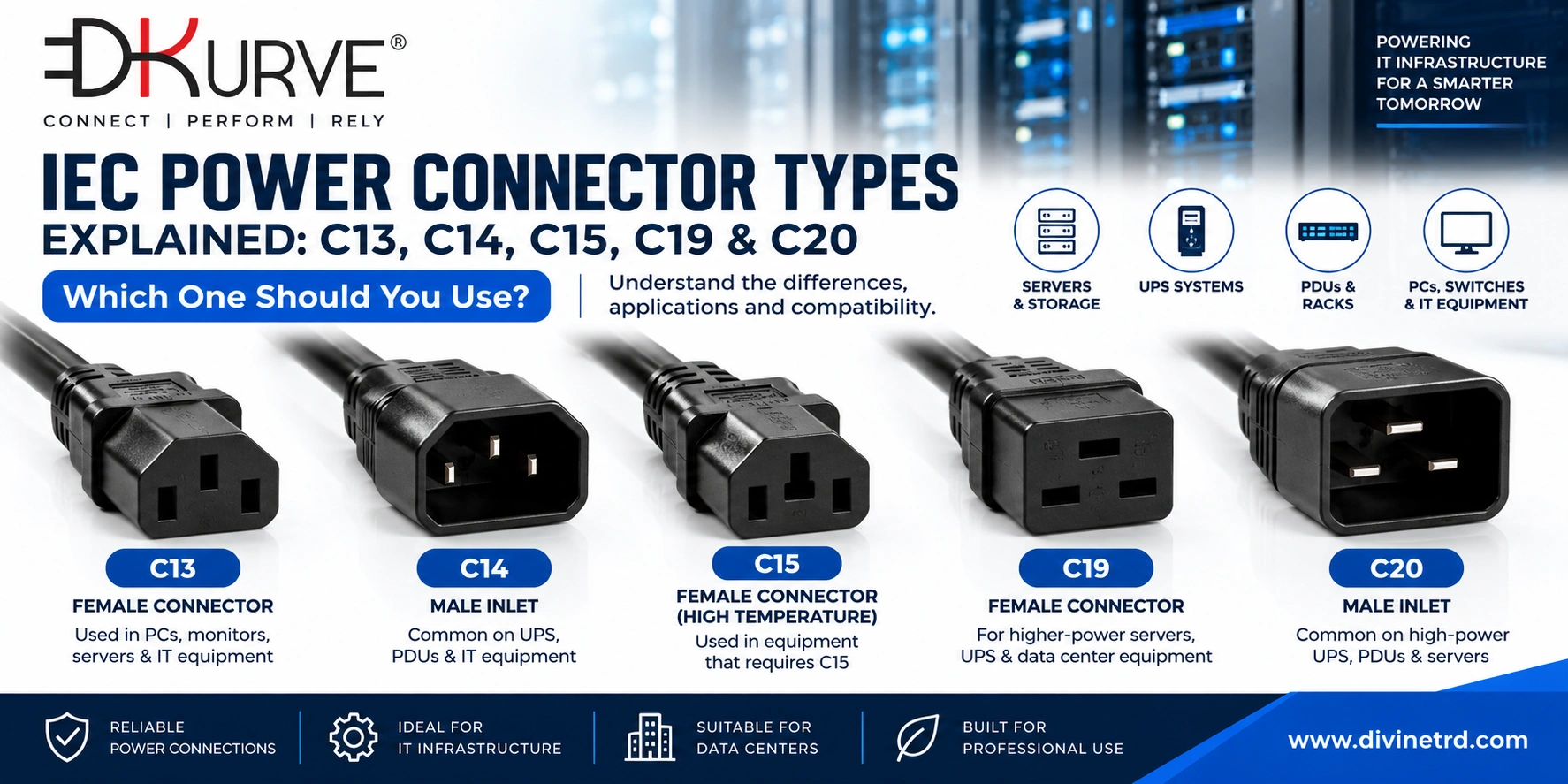
The IEC C13 is one of the most recognizable power connectors used in IT environments.
It is commonly seen on power cables for:
- Desktop computers
- Monitors
- Network switches
- Servers
- Printers
- UPS-connected equipment
- Other compatible IT devices
A typical example is a UK 3-pin to IEC C13 power cable, where the UK plug connects to the wall socket and the C13 connector connects to the equipment.
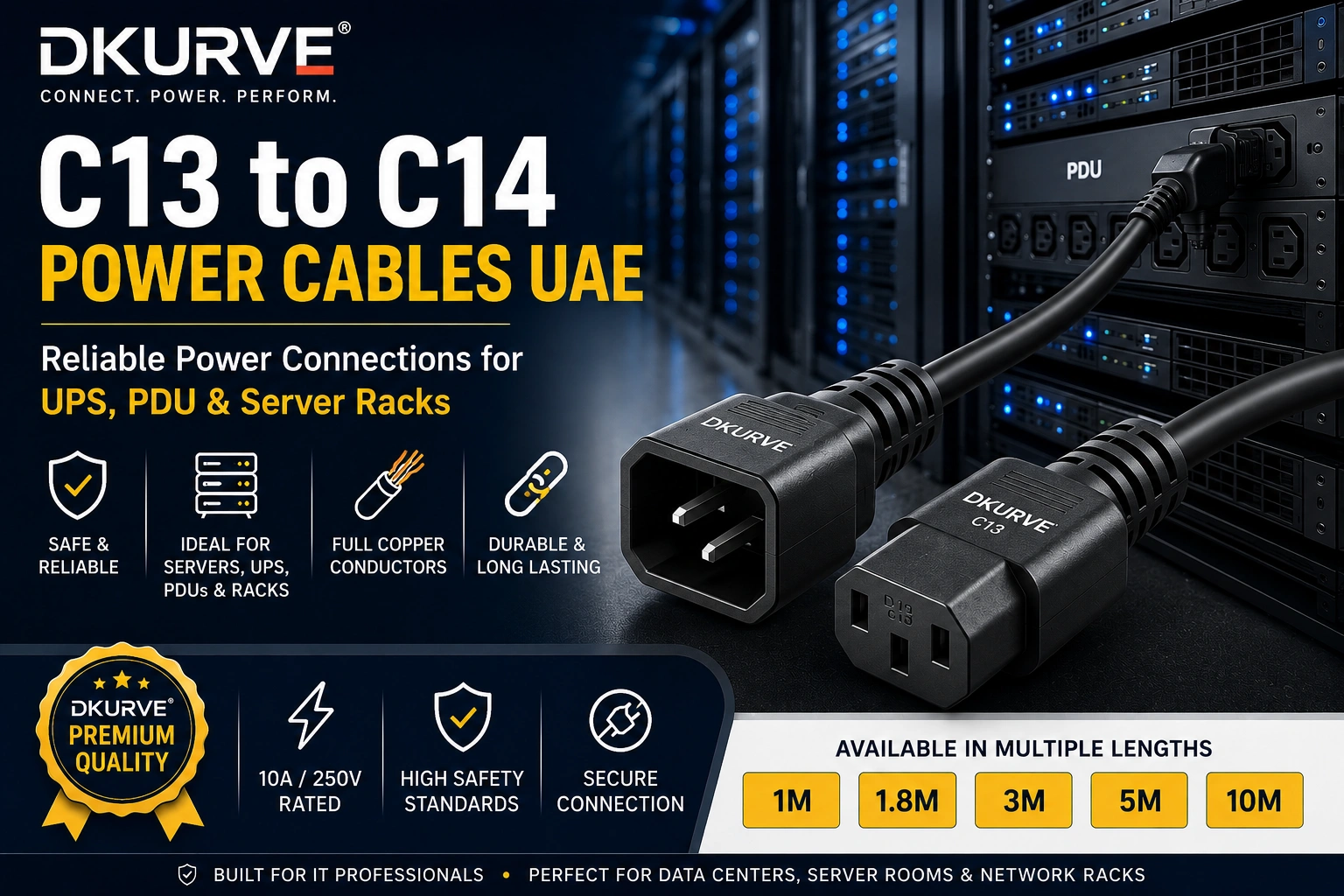
Another common configuration in server racks is a C14 to C13 power cable, allowing compatible equipment to be connected to a UPS or rack PDU.
Common C13 cable configurations
UK Plug → C13
Useful for connecting compatible IT equipment directly to a UK/UAE-style power outlet.
C14 → C13
Frequently used for compatible UPS, PDU, server and rack applications.
IEC C14 – Common for UPS and PDU Connections
The IEC C14 is the mating connection commonly associated with a C13 connector.
You'll frequently see C14 connections on:
- Computers
- Servers
- UPS systems
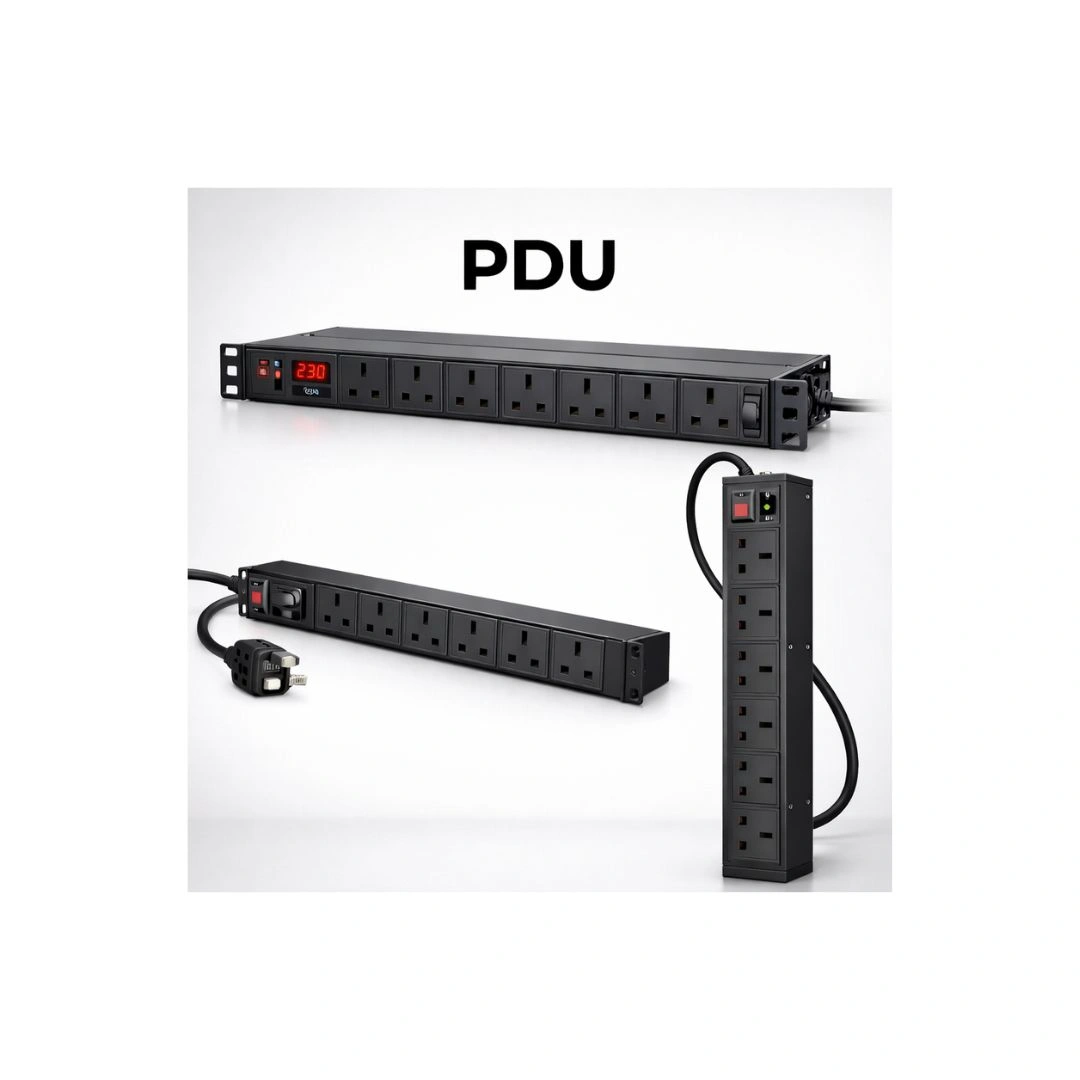
- PDUs
- Professional IT equipment
C14 is also widely used as the input or plug side of power extension cables used inside network and server racks.
For example:
C14 → C13
This configuration can provide a clean connection between compatible PDU/UPS outputs and IT equipment without requiring a UK 3-pin plug.
This is one reason C13-to-C14 cables are widely used in professional rack installations.
IEC C13 vs C14 – What's the Difference?
C13 and C14 are closely related but they are not the same connector.
The easiest way to understand them is:
C13 = female cable connector
C14 = corresponding male inlet/plug
In many installations, a cable has a C14 connection at one end and C13 at the other.
This makes the C13-to-C14 configuration particularly useful for connecting compatible:
PDU → Server
UPS → Server
PDU → Network Equipment
UPS → IT Equipment
The actual compatibility must always be confirmed from the sockets and electrical ratings of the equipment being connected.
IEC C15 – What Is the Notch For?
The IEC C15 looks similar to a C13, which can sometimes cause confusion when selecting a replacement cable.
The easiest visual difference is the characteristic notch in the C15 connector.
C15 connectors are designed for applications requiring a higher temperature rating than the standard C13/C14 combination.
This makes connector identification important.
If your equipment requires a C15 connection, don't simply order a C13 cable because the connectors appear similar in a photograph.
Common C15 cable configurations
Depending on the equipment and installation, you may encounter:
or
C14 → C15
These configurations can be used with compatible equipment where a C15 connector is required.
C13 vs C15 – How Can You Tell the Difference?
The two connectors are visually similar.
The easiest identification point is:
C13: Standard IEC connector profile.
C15: Similar overall shape but incorporates the characteristic notch associated with the C15 design.
The difference isn't simply cosmetic. The C15 is designed for a different temperature classification.
Therefore, always check the equipment specification before choosing between C13 and C15.
IEC C19 – For Higher-Power IT Equipment
The IEC C19 is a larger connector than C13 and is commonly found in higher-power IT and data-center applications.
Typical applications can include compatible:
- High-power servers
- Enterprise UPS systems
- Rack PDUs
- Storage equipment
- Data-center hardware
- High-power IT equipment
The larger physical design also makes a C19 relatively easy to distinguish from a C13.
Depending on the installation, C19 can be found in several useful cable configurations.
For example:
UK 3-Pin Plug → C19
The correct configuration depends on both the power source and the equipment being connected.
IEC C20 – The Mating Connection for C19
The IEC C20 is commonly paired with the C19 connector.
A C19-to-C20 power cable is therefore frequently found in professional server, UPS, PDU and data-center environments where compatible C19/C20 connections are provided.
Compared with C13/C14 connections, the C19/C20 family is designed for higher-current applications.
However, the presence of a C19 or C20 connector alone should never be used to assume the electrical capacity of the entire installation.
Always check:
Equipment rating + connector rating + cable conductor specification + PDU/UPS rating
before installation.
C19 vs C20 – What's the Difference?
Just as C13 and C14 form a mating connector pair, C19 and C20 are closely related.
In simple terms:
C19 = female cable connector
C20 = corresponding male inlet/plug
A typical C20-to-C19 power cable can therefore connect compatible high-power equipment to a suitable UPS or PDU.
The C19/C20 connector family is physically larger than C13/C14, which makes identification relatively straightforward.
C13/C14 vs C19/C20 – Which Should You Use?
There isn't one connector that is automatically "better."
The correct choice depends on your equipment.
For many standard IT devices, C13/C14 connections are common.
For equipment designed for higher-current connections, C19/C20 may be specified.
The key rule is:
Choose the power cable according to the equipment inlet, power source outlet and electrical specifications — not simply by appearance.
If your server has a C14 inlet, for example, you need a compatible connector for that inlet.
If your equipment has a C20 inlet, you will generally be looking for a compatible C19 connection.
Which IEC Power Cable Do I Need for a Server?
There is no single universal "server power cable."
Different servers can use different IEC connections depending on their design and power requirements.
Common server-rack configurations include:
C14 to C13
Frequently used between compatible rack PDUs or UPS systems and servers/network equipment.
C20 to C19
Common in higher-power compatible server and data-center equipment.
UK Plug to C13
Useful when compatible equipment needs to connect directly to a standard UK/UAE-style socket.
UK Plug to C19
Available for equipment requiring a C19 connection while the power source is a suitable UK-style socket.
Before ordering, check both ends of the connection.
Don't Forget Cable Conductor Size
The connector type is only one part of selecting the correct power cable.
You may see IEC power cables manufactured using different conductor sizes, such as:
1.0mm²
1.5mm²
2.5mm²
A thicker conductor does not automatically mean that a cable is appropriate for every application. Connector ratings, plug ratings, cable construction, equipment requirements and the complete electrical circuit must all be considered.
This becomes particularly important with servers, UPS systems, PDUs and higher-power IT equipment.
Full Copper vs CCA Power Cables
Cable conductor material is another important consideration.
Full copper conductors provide different electrical characteristics from CCA (Copper-Clad Aluminium) conductors.
For professional IT infrastructure, buyers should check the actual cable specification rather than relying only on the connector appearance or cable thickness.
A cable may look heavy-duty externally while having very different internal conductor construction.
When purchasing IEC cables for professional installations, check:
Conductor material
Conductor size
Current and voltage rating
Connector type
Cable length
Equipment compatibility
Choosing IEC Power Cables for UPS Systems
When choosing a cable for a UPS, first identify the UPS output connector.
Then identify the inlet on the device receiving power.
For example, if a UPS provides compatible C13 outlets and the connected equipment has a C14 inlet, the appropriate cable configuration will differ from an installation using C19/C20 connections.
Don't choose the cable based simply on the word "UPS cable."
Check the actual connectors on both devices.
Choosing Power Cables for Rack PDUs
Rack PDUs can have several different input and output configurations.
Depending on the PDU, you may encounter IEC C13, C14, C19 or C20 connections.
For a professional rack installation, also consider cable length.
Using an unnecessarily long cable inside a rack can create excessive cable loops and make cable management more difficult.
Shorter IEC cables can be useful for equipment located close to the PDU, while longer cables provide greater flexibility when equipment and power sources are further apart.
IEC Power Cables for Servers, UPS, PDU & Data Centers in UAE
Divine Plus Trading LLC supplies professional IEC power cables and power connectivity products for IT infrastructure applications across the UAE.
The DKURVE® range includes multiple IEC configurations for different equipment and installation requirements, including:
C13 to C14 Power Cables
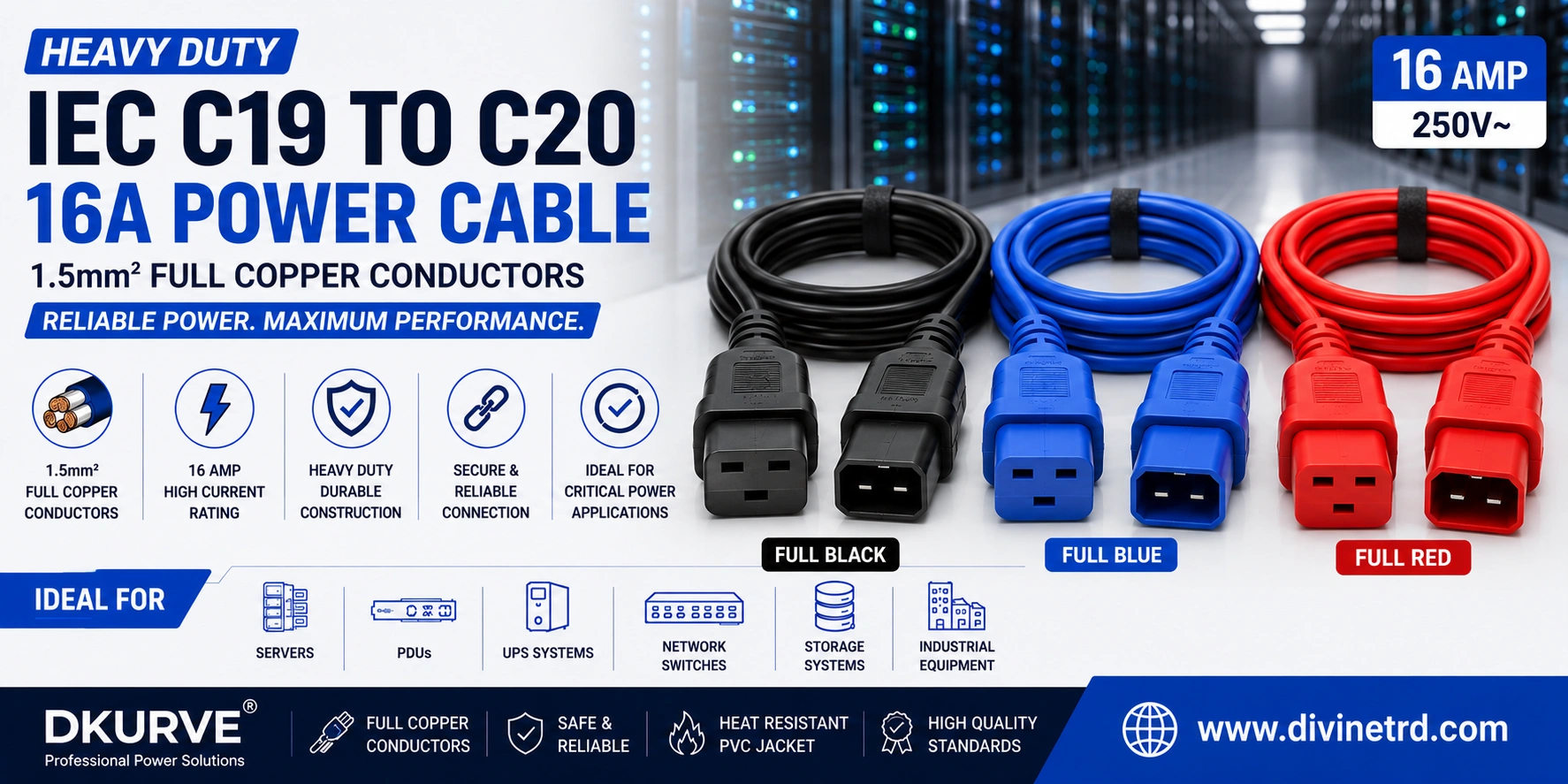
C19 to C20 Power Cables
C19 to C14 Power Cables
UK Plug to C13 Power Cables
UK Plug to C15 Power Cables
UK Plug to C19 Power Cables
Multiple lengths and conductor sizes are available across selected models, making it easier to choose cables for servers, UPS systems, rack PDUs, network cabinets, data centers and professional IT equipment.
View IEC Power Cables & Adapters at Divine Plus Trading
Frequently Asked Questions
What is the difference between IEC C13 and C14?
C13 is the female cable connector, while C14 is its corresponding male inlet/plug. C13-to-C14 cables are commonly used with compatible servers, UPS systems, PDUs and other IT equipment.
What is the difference between C13 and C15?
C13 and C15 look similar, but C15 has a distinctive notch and is designed for a higher temperature classification. Always check which connector your equipment requires.
What is the difference between C19 and C20?
C19 is the female cable connector and C20 is its corresponding male inlet/plug. C19/C20 connections are commonly found on compatible higher-power IT, UPS, server and PDU equipment.
Are C13/C14 and C19/C20 interchangeable?
No. They are physically different connector families and are intended for different equipment requirements. Always use the connector specified for your equipment.
Which IEC cable should I use for a server?
It depends on the server's power inlet and the available outlet on the UPS or PDU. C13/C14 and C19/C20 configurations are both commonly encountered in server environments.
What does 1.0mm², 1.5mm² or 2.5mm² mean on a power cable?
It refers to the cross-sectional area of the cable conductor. The correct conductor size should be selected according to the cable design, electrical load, connector ratings and equipment requirements.
Where can I buy IEC power cables in UAE?
Divine Plus Trading LLC supplies DKURVE® and other professional power connectivity products for servers, UPS systems, PDUs, network racks and IT infrastructure in the UAE.
Recent Posts
IEC Power Cable Connector Types Explained: C13, C14, C15, C19 & C20 Differences
Long-Distance USB Connectivity with LinkAura Active Optical Cables
C13 to C14 Power Cable UAE – Complete Guide for UPS, PDU & Server Rack Connections
Heavy Duty IEC C19 to C20 16A Power Cable – 1.5mm² Full Copper | Blue, Red & Black

Bulk IT Networking Products for System Integrators & Resellers in UAE

Professional Network Cable Testers & Installation Tools for UAE, GCC & Africa
DKURVE®

Divine Plus Trading LLC is a Dubai-based supplier of IT networking, data center, and connectivity solutions, specializing in IEC power cords, rack PDUs, network cables, fiber optic products, and IT accessories. We provide reliable infrastructure solutions for modern IT and data center environments.